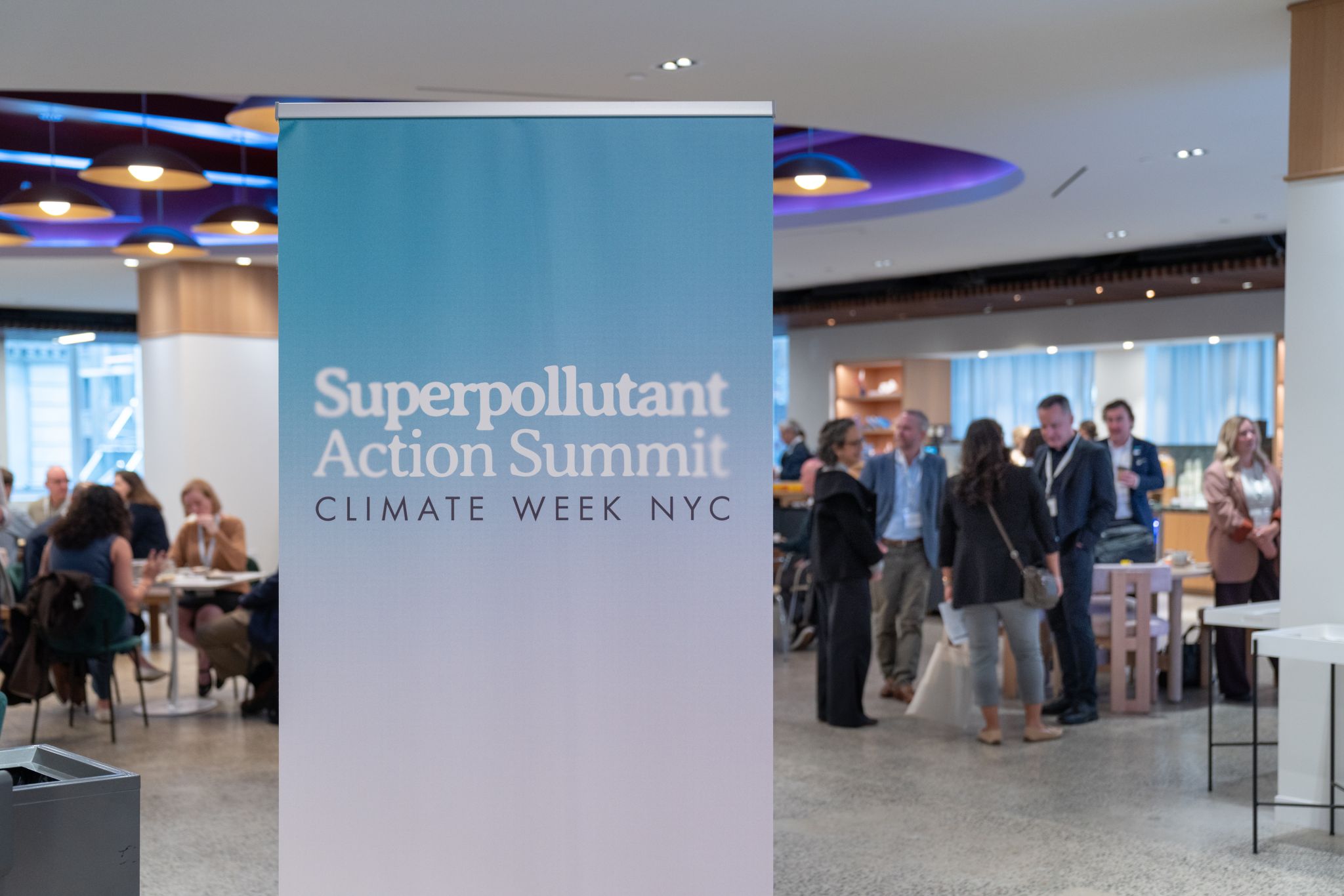
Climate Advisers, alongside the Institute for Governance & Sustainable Development (IGSD) and Asia Society Policy Institute, convened a high-level event of US government officials and civil society experts to discuss overlooked climate opportunities to address industrial nitrous oxide (N2O) emissions for the US and China.
The event featured speakers including Ali Zaidi, Assistant to the President and National Climate Advisor, and John Podesta, Senior Advisor to the President for International Climate Policy, Richard Duke, Deputy Special Envoy for Climate at the U.S. Department of State, and Manish Bapna, President of the Natural Resources Defense Council, alongside other industry and university experts
N2O: The “Forgotten Greenhouse Gas”
From the outset, speakers emphasized that, even though N2O is 273 times more powerful than carbon dioxide and can persist in the atmosphere for over a century, N2O does not garner the attention that other greenhouse gasses do. US government officials highlighted the importance of recognizing the harm posed by increasing N2O emissions. “Most of the discussion of climate change focuses on carbon dioxide, but super pollutants like methane and nitrous oxide cause half of the climate change we’re experiencing today,” said John Podesta.
Prof Jianxin Hu, from Peking University, and Prof David Kanter, Associate Professor at New York University and Global Chair of the International Nitrogen Initiative, noted there are numerous non-climate co-benefits of N2O mitigation efforts. Reductions in N2O emissions can significantly improve air quality and water quality and allow the ozone layer to recover from damage caused by N2O and other ozone-depleting substances. Speakers agreed that greater awareness of the harm of N2O emissions—and the opportunities to reduce them—is a critical first step to foster collaboration and greater ambition in curbing the non-CO2 gas.
Dr. Jiang Lin, Nat Simons Presidential Chair in China Energy Policy, Berkeley Lab, emphasized that dialogue on N2O is necessary to take advantage of plentiful opportunities to reduce industrial N2O emissions: “This is the overlooked opportunity, and I commend everyone here for putting a spotlight on this opportunity. Even though it is difficult to scale up, there are solutions.” Providing closing remarks Manish Bapna of NRDC stated, “This is a big opportunity… The fruit is large, it’s low [hanging], it’s ripe.”
Importance of U.S.-China Cooperation on Reducing N2O Emissions
US government officials emphasized the need for greater cooperation between the United States and China—countries together responsible for 80% of global industrial N2O emissions—to identify and implement solutions. Zaidi emphasized the steps the US government is already taking to address N2O emissions from all sources. Both Podesta and Duke noted that, because of recent efforts by ClimeCo to work with Ascend Performance Materials and a few other companies, the United States will reduce its N2O emissions 50% from 2020 levels by early next year.
In addition, Podesta affirmed the Biden-Harris administration’s continued commitment to centering super pollutants in its diplomatic relations with China, saying that the low cost of cutting nitrous oxide and other super-pollutant emissions makes it a “core component of US engagement with China on climate.” He added that China’s commitment to include all greenhouse gasses in its 2035 Nationally Determined Contribution (NDC) was a sign of progress. China’s commitment—announced at Sunnylands, California last year—marks a departure from previous NDCs that included emissions reductions targets for CO2 alone. The inclusion of super-pollutant emissions in China’s NDC is “equivalent to bringing an Australia size economy into the Paris Agreement,” Duke noted.
Of particular note during the event was the opportunity the voluntary carbon market offers to catalyze new ambition to tackle N2O emissions in both the US and China. Bill Flederbach, President and CEO of ClimeCo, an N2O carbon market project developer, announced his company’s commitment to expand beyond its US-based projects to launch four new adipic projects in China with the potential to prevent the release of N2O emissions equivalent to 60 million tons of carbon dioxide (CO2). ClimeCo’s work with Ascend Performance Materials to abate emissions from its adipic acid plant in Pensacola, Florida, was also highlighted later that day at the White House Summit on Super Pollutants. While Climate Advisers’ event saw significant discussion of voluntary carbon market opportunities, several speakers noted that policy and regulation are also necessary to solve the full range of industrial N2O challenges.
Important Announcements and Next Steps
Podesta announced his intention to travel to China to meet with his Chinese counterpart later this year ahead of the super pollutants summit at COP29. Kanter indicated that there will be a soft launch of the forthcoming CCAC N2O assessment during New York Climate Week (NYCW) in September, ahead of the full, official launch during the Meeting of the Parties to the Montreal Protocol (MOP) in late October.
Climate Advisers’ Joshua McBee noted that we are in the process of building a new initiative to increase global ambition to address N2O emissions, launching later this year. To stay informed, including on plans for NYCW and COP29, visit n2oaction.org and subscribe for updates. If you are interested in getting involved directly, please contact Mumukshu Patel, Senior Director of Food & Agriculture at Climate Advisers on patel@climateadvisers.org.
With new focus and efforts regarding N2O on the horizon, there is a chance that N2O will no longer be the forgotten greenhouse gas. In fact, we may soon see unforgettable levels of international climate cooperation. For more information on industrial N20 emissions, you can read our latest blog here.