During the first week of COP29, the Climate and Clean Air Coalition (CCAC), a UN Environment Programme (UNEP) initiative, launched the Global Nitrous Oxide Assessment, as part of an event hosted by Climate Advisers. The assessment, by UNEP and the Food and Agriculture Organization of the United Nations (FAO), is the definitive global scientific assessment, along with the Global Nitrous Oxide Budget, highlighting the abatement challenges and opportunities for the third leading greenhouse gas responsible for global warming after carbon dioxide and methane.
Speakers at the event included: Ali Zaidi, Assistant to the President, and White House National Climate Adviser; Martina Otto, the Head of the CCAC; Martial Bernaux, Team Leader Natural Resources at the FAO; David Kanter, Chair of the International Nitrogen Initiative (INI) and lead author of the Global Nitrous Oxide Assessment; Bill Flederbach, CEO of ClimeCo; and Mumukshu Patel, Senior Director of Food and Agriculture at Climate Advisers.
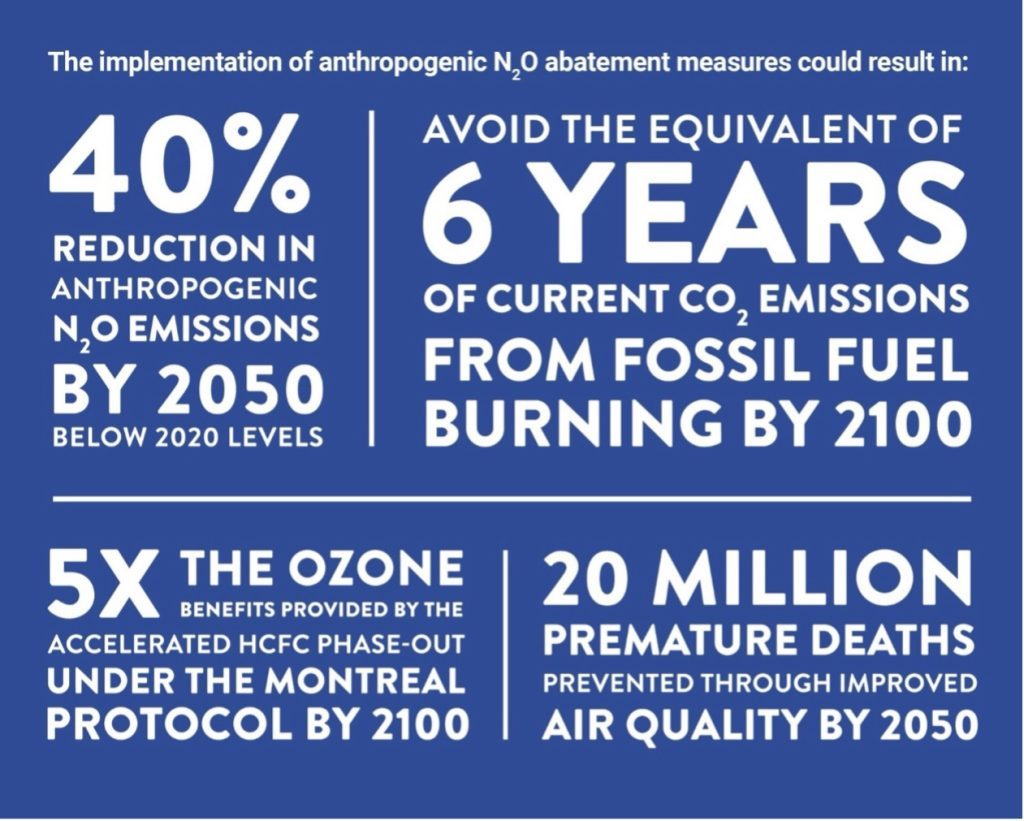
Source: CCAC , Global Nitrous Oxide Assessment.
The focus of the event was on action to tackle N2O emissions that are rising faster than the worst projections and are the most potent ozone depleting substance in existence today. As David Kanter pointed out: “This new assessment shines light on a major greenhouse gas and ozone depleting substance that we can no longer afford to ignore. Keeping 1.5 alive and protecting the legacy of the international ozone agreement are impossible without ambitious nitrous oxide abatement.”
Mr. Zaidi opened the event stating, “The Global N2O Assessment — released today — is a critical step in catalyzing global action to address this neglected greenhouse gas.” He highlighted the opportunity for N2O mitigation broadly, and on the industrial front in particular, pointing to the US commitment to abate industrial N2O emissions by 50 percent. He also stressed the need to address all super-pollutants and pointed to the White House Summit on Super-pollutants and the Non-CO2 Summit among Azerbaijan, US and China as evidence that high level action is possible on this front.
Martina Otto, CCAC, officially launched the report, saying “this Assessment on a forgotten greenhouse gas takes science to action, highlighting the multiple climate and health co-benefits that come with N2O emissions reductions. As we did following the release of the Global Methane Assessment, we must now act on the findings.” Martial Bernaux, FAO, commended the Assessment’s scientific team on being sensitive to food and nutrition security and farmers’ livelihoods concerns, while addressing N2O emissions.
Bill Flederbach, ClimeCo, refocused the issue on industrial emissions saying that they can be addressed immediately and cost-effectively. “Through innovative, site-specific solutions, ClimeCo has made significant strides in reducing N2O emissions — specifically within the industrial sector — achieving measurable results on a global scale- across Asia and North America. However, much more needs to be done. ClimeCo is driving forward a powerful solution against climate change.”
Mumukshu Patel, Climate Advisers, highlighted solutions to address N2O emissions. “The Assessment documents that existing technologies offer up to 40 percent abatement potential for nitrous oxide by 2050, from 2020 levels. This includes food systems related emissions. Science has spoken and we now need to promote the solutions and act.” He pointed to the launch of the global N2O Hub as a key mechanism to showcase solutions and build partnerships, and advocate for action.
The event was hosted at the U.S. Center, in partnership with CCAC, the U.S. Department of State and the INI, prior to the COP29 Summit on Methane and Non-CO2 Greenhouse Gases led by Azerbaijan (COP29 President), China and the United States. The event was part of a series that Climate Advisers hosted at COP29 to raise the profile of N2O and super-pollutants within the climate community, including the launch of the N2O Hub, convened by Climate Advisers, during the second week of COP29.
You can find out more about the hub at: www.n2oaction.org.